Digital Breakthrough for Fashion Brands: Building a High-Converting Online Boutique with WordPress
In the wave of digitalization sweeping the fashion industry, online platforms have long transcended their role as mere sales channels to become core windows for brands to convey aesthetic concepts and tell their brand stories. A website that combines visual appeal with user experience can make the delicate texture of clothing, the ingenuity of design, and the brand’s value proposition reach global consumers beyond geographical boundaries. WordPress, with its highly flexible customization capabilities and rich ecosystem of features, has emerged as the “golden tool” for fashion brands to build their digital homes. As a brand operator, how can you leverage WordPress to create a fashion website that aligns with your brand identity while effectively driving revenue growth? The following five core points break down the practical roadmap for you.
I. Visual Storytelling: Let Design Be the “Silent Spokesperson” for Your Brand
Fashion, by its very nature, thrives on visual resonance. A website must capture visitors’ attention within 0.5 seconds and convey the soul of the brand through design language.
1. Choose the Right Theme to Set a Premium Tone
Move beyond one-size-fits-all generic themes and prioritize WordPress themes tailored specifically for fashion, luxury, or designer brands. For instance:
- Avenue, which focuses on minimalism, comes with full-screen product galleries and dynamic transition effects, making it ideal for niche designer brands.
- Flatsome, which balances functionality and aesthetics, includes a built-in Lookbook module that enables scenario-based outfit displays directly.
- Kalium’s advanced typesetting features perfectly showcase the intricate details of haute couture clothing.
These themes come with built-in features like parallax scrolling and video backgrounds, allowing brands to add depth to their image without additional development work.
2. Use Minimalist Whitespace to Highlight Products as the Core
Let products take center stage on the page. Adopt a clean grid layout and reserve ample whitespace (it is recommended that the spacing between page elements be no less than 20px) to avoid cluttering the interface with excessive decorative elements that distract users from the products. For example, the “full-screen single product display” design commonly used on luxury brand websites, paired with a light gray background, enhances the sophistication of the clothing’s colors and cuts while effectively increasing users’ focus on the products.
3. Typography and Color: Build a Unified Brand Visual Language
Typography is a direct reflection of a brand’s personality:
- Serif fonts (e.g., Playfair Display) are suitable for conveying a retro, elegant brand tone and can be used for headings.
- Sans-serif fonts (e.g., Montserrat) are sleek and modern, making them more suitable for body text to ensure readability across devices.
Color matching must strictly adhere to the brand’s Visual Identity (VI) system. For example, brands focusing on sustainability may use earth tones, while young, trendy brands can experiment with high-saturation color contrasts. However, it is advisable to use no more than 3 colors throughout the page to maintain visual consistency from buttons and headings to product labels.
4. High-Definition Visual Content: Bring Products to Life
High-quality visual content is the core competitive advantage of a fashion website. Invest in shooting high-resolution product images (with a recommended resolution of no less than 1200×1800 pixels) and provide 360° rotation viewing and detail zoom functions, allowing users to clearly see the fabric texture and craftsmanship details. At the same time, incorporate dynamic content: for example, shoot short videos of models walking to showcase the drape of the clothing, or create behind-the-scenes clips of fabric production paired with concise copy to infuse static products with a sense of storytelling.
II. Seamless Commercial Experience: Make Shopping an “Aesthetic Enjoyment”
An aesthetically pleasing page is the foundation, but a smooth conversion path is the key to driving revenue growth. The process from browsing to checkout should be as effortless and enjoyable as flipping through a fashion magazine.
1. Build a Full-Cycle E-Commerce Ecosystem with WooCommerce at Its Core
As the most mature e-commerce plugin in the WordPress ecosystem, WooCommerce covers all scenarios of fashion e-commerce:
- It supports the listing of multi-variant products (e.g., combinations of clothing colors, sizes, and materials).
- Inventory alerts (e.g., “Only 3 pieces left in this size”) can be implemented through plugins.
- It integrates with logistics interfaces such as DHL and FedEx, enabling users to track their orders in real time.
Additionally, its rich payment plugins (e.g., Stripe, PayPal) cater to the payment habits of global users, lowering payment barriers.
2. Intelligent Product Display: Improve Decision-Making Efficiency and Average Order Value (AOV)
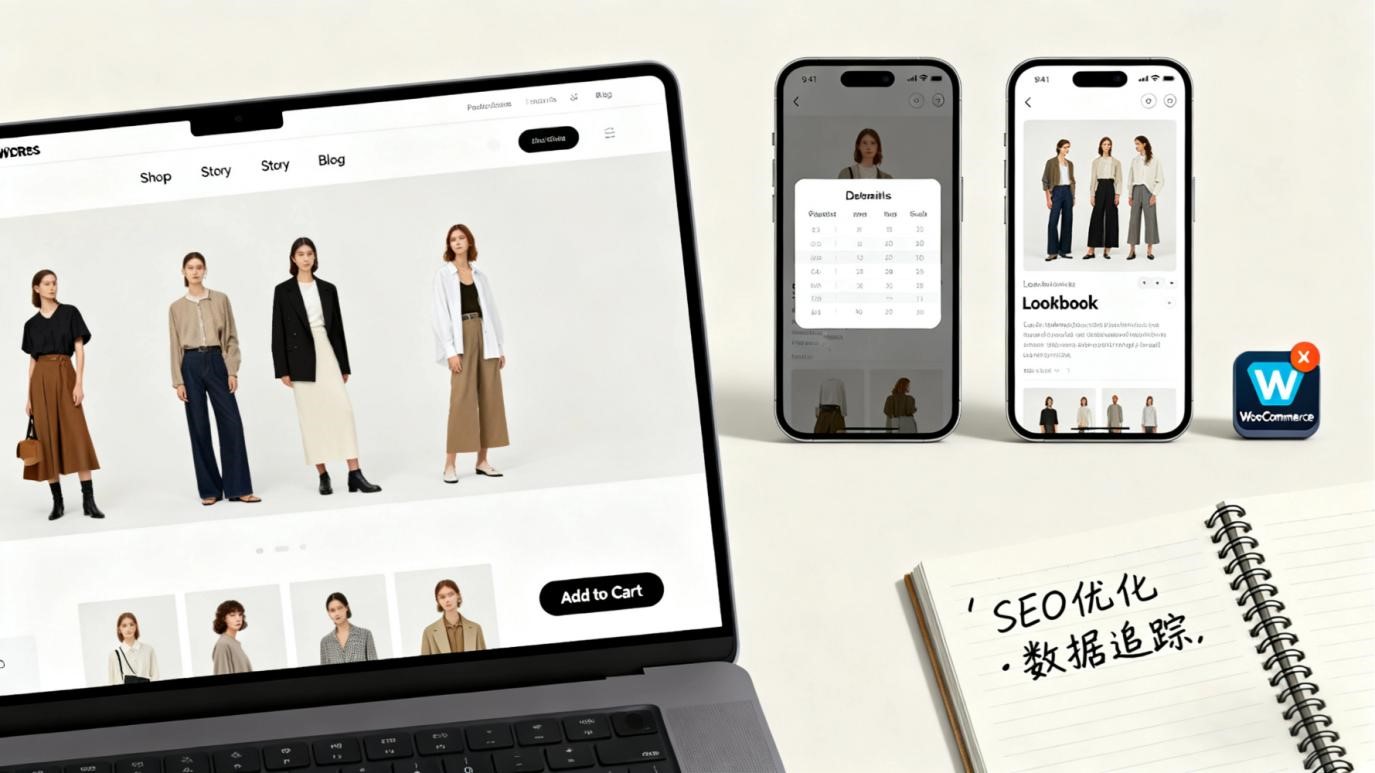
- Accurate Variants and Size Guides: In addition to clearly labeling color and size options, create visual size guides—for example, use real models to show how different sizes fit, or provide a “waist-hip-length” comparison table with practical tips like “For loose fits, we recommend sizing down.” Such measures can reduce return rates by over 30%.
- Scenario-Based Lookbook Functionality: Emulate the “outfit recommendation” logic of offline stores. On the Lookbook page, users can click on a shirt worn by a model to be directed straight to the product purchase page. At the same time, offer promotions like “10% off when purchasing as a set” to effectively increase AOV. For example, fast fashion brands often use themed Lookbooks such as “Office Wear Sets” or “Date Night Outfits” to significantly boost users’ purchasing desire.
3. Simplify the Checkout Process: Eliminate Every “Abandonment Point”
Reduce the checkout process to no more than 3 steps (Cart → Shipping Information → Payment) and offer a “guest checkout” option to avoid user churn caused by forced account registration. Prominently display trust badges (e.g., PayPal security logos, credit card brand icons) on the payment page, and add benefit reminders such as “7-Day Free Returns” and “Free Shipping on Orders Over 200 Yuan” to ease users’ decision-making concerns. Data shows that an optimized checkout process can reduce cart abandonment rates by 25%.
III. Content Is King: Build a Brand “Moat” Through Value-Driven Content
Truly influential fashion brands do more than just “sell products”—they “convey a lifestyle.” High-quality content helps shape a brand’s professional image and emotional connection within the industry.
1. Create a “Digital Magazine-Style” Premium Blog
A blog should not be a simple platform for new product announcements, but rather a “fashion guide” for users. Examples include:
- Trend Analysis: “2024 SS Color of the Season: How to Style ‘Serene Blue’ for Office Wear”
- Craftsmanship Education: “The Making of a Silk Shirt: 6 Steps from Silkworm Cocoon to Finished Garment”
- Character Stories: “Designer Interview: Why We Insist on Using Recycled Fabrics for Children’s Clothing”
In-depth content showcases the brand’s professionalism and values while accumulating high-quality keywords for SEO.
2. Use Page Builders to Tell a Compelling Brand Story
Leverage visual page builders like Elementor or WPBakery to create a dedicated brand story page. For example:
- At the top, use a full-screen video to showcase the craftsmanship process in the brand’s workshop.
- In the middle section, use a mix of images and text to tell the founder’s story, such as “Starting a Business Out of a Love for Vintage Fabrics.”
- At the bottom, add a “Sustainability Commitment” timeline to highlight the brand’s milestones—from “adopting eco-friendly packaging” to “launching an organic cotton collection.”
Emotional storytelling helps transform consumers’ “liking for products” into “recognition of the brand.”
IV. Technical Optimization: Invisible “Custom Details” That Determine User Retention
Beneath the polished surface of a website lies a solid technical foundation. While technical optimization may not be “visible,” it directly impacts user experience and conversion rates.
1. Speed Optimization: Don’t Let Slow Loading “Drive Away” Users
Fashion users have extremely low tolerance for waiting—every 1-second increase in website loading time can lead to a 7% drop in conversion rates. Optimization solutions include:
- Image Optimization: Use plugins like TinyPNG to compress images and convert them to the WebP format, reducing file size while maintaining clarity.
- Hosting Selection: Prioritize hosting providers that support PHP 8.0 or higher and offer CDN acceleration (e.g., SiteGround, WP Engine).
- Caching Plugins: Install WP Rocket to enable page caching, browser caching, and database optimization, which can improve website loading speed by over 50%.
2. Mobile-First Approach: Capture “Fashion Consumers on the Go”
Statistics show that 75% of fashion users browse websites via mobile devices—mobile experience directly determines conversion success. Ensure that:
- The theme is 100% responsive, and test it across different mobile devices (e.g., iPhones, Android phones) to avoid issues like tiny text or misaligned buttons.
- Optimize Touch Experience: Ensure that the spacing between product cards is no less than 15px to prevent accidental clicks; make payment buttons no smaller than 44×44px for easy one-handed operation.
- Simplify Mobile Processes: For example, fix the “Add to Cart” button at the bottom of the screen to reduce the need for users to scroll.
3. SEO Optimization: Help Your Target Audience Find You
Acquiring targeted traffic through SEO is a long-term growth driver for fashion websites. Key steps include:
- Use plugins like Yoast SEO or Rank Math to optimize meta titles (e.g., “2024 Summer Silk Dress – Mulberry Silk, Slim-Fit, Direct from Brand”) and meta descriptions for each product and blog post, incorporating core keywords.
- Add ALT tags to product images (e.g., “White Linen Shirt – Loose Fit, Suitable for Office Wear”) to improve image search rankings.
- Write blog posts targeting long-tail keywords, such as “How to Choose Jeans for Curvy Figures” or “Height-Increasing Styling Tips for Petite Women,” to cover more niche user needs.
V. Data-Driven Strategy and Ongoing Engagement: Keep Your Website “Alive”
Launching a website is not the end—it is the beginning of ongoing interaction between the brand and users. Optimize operations through data and build a community of loyal customers.
1. Data Analysis: Guide Decisions with Data
Integrate Google Analytics 4 (GA4) and focus on three key metrics:
- User Behavior: Track the conversion funnel from “Product Detail Page → Add to Cart → Checkout” to identify stages with high churn rates (e.g., a high drop-off rate at the “Shipping Information” stage may indicate that the form is too long).
- Top-Performing Products: Identify products with both high traffic and conversion rates, and prioritize increasing inventory and marketing efforts for these items.
- Content Performance: Analyze the read time and bounce rate of blog posts to focus on content types that resonate with users (e.g., if “styling tips” articles have longer read times, increase the output of such content).
2. Community Building: From “Traffic” to “Loyalty”
- Integrate Social Media: Embed official Instagram feeds on the homepage to display user-generated content (UGC) such as outfit posts tagged with “#BrandNameOOTD,” increasing social proof.
- Email Marketing: Use plugins like Mailchimp for WordPress to add pop-ups (e.g., “Subscribe to Get a 10-Yuan Coupon”) at the bottom of blog posts or on product detail pages to grow your email list. Send regular personalized content, such as “New Arrival Previews,” “Exclusive Member Discounts,” and “Styling Guides,” to cultivate user loyalty.
- Interactive Campaigns: Launch website campaigns like “Share Your Outfit to Win a Free Purchase,” where users can upload photos of themselves wearing the brand’s products and share them on social media to enter a giveaway. This not only boosts user engagement but also generates more UGC.