Building the URL Structure for Fashion E-commerce Websites: A Key Step from User Experience to Traffic Conversion
In the field of fashion e-commerce, a seemingly simple URL structure is actually a core link connecting user needs and business goals. Data shows that users form a first impression of a website in just about 50 milliseconds, and 77% of organizations believe that poor user experience is a key shortcoming hindering customer conversion. For fashion e-commerce platforms, users not only care about product design but also pay more attention to how quickly they can find their favorite items – this is exactly the key scenario where the URL structure plays a role. This article will comprehensively break down how to build a fashion e-commerce URL structure that conforms to both user habits and search engine rules, covering aspects from architecture selection and construction techniques to practical value.
I. Choosing the Right Architecture: The “First Checkpoint” for User Retention
The development structure of your fashion e-commerce website depends on how you organize website navigation, user flows, user experience, and how you help customers achieve conversions and goals based on business needs. In other words, the optimal fashion website structure includes elements such as a concise navigation bar and internal links that set clear goals for website visitors. A rule of thumb is that it should take no more than 3 clicks to reach a product from the homepage. Let’s take a practical look at the differences between flat architecture and deep architecture by referring to the picture below.
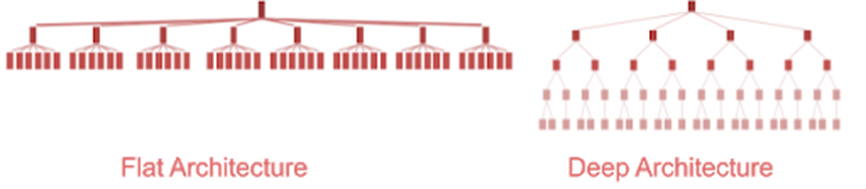
Sitemap for Conversion Rate Optimization (CRO) in fashion e-commerce: On the left is the flat architecture, which includes the homepage, 8 category pages, and each category page has 6 product pages. On the right is the deep architecture, which includes the homepage, 4 category pages, followed by two levels of subcategory pages, with only one or two product pages under each subcategory. Among the above architectures, the flat architecture can be used as a rule of thumb for us to determine the ideal e-commerce website structure. Why? Because the flat architecture allows users to navigate seamlessly without 6-7 clicks. Users can more easily and quickly find relevant information about specific products while avoiding the troubles caused by poor user experience.
From an SEO perspective, due to the low degree of page ranking dilution in the flat architecture, pages can gain more ranking weight from each other. The more clicks users need to make to access lower-level pages, the more the link weight will be filtered out, meaning the remaining weight of deep-seated pages will be less, and it will also be more difficult for Google crawlers to index them. Key point: Overall, the ideal structure setup should ensure that all products are only 2 clicks away from the homepage; every page of the website should be easy to crawl and navigate; and customers must be able to easily and quickly find the exact information they are searching for.
II. Five Practical Tips for Building an Efficient URL Structure
(I) Design the Hierarchical Structure from Top to Bottom
The actual management of a website has a significant impact on conversion rates, website traffic, and product sales. A fashion website design that properly organizes all category and subcategory pages is necessary. A proactive top-down strategy must be followed during the website design and development process. As mentioned above, for the 3-click method, the following structure can be adopted:
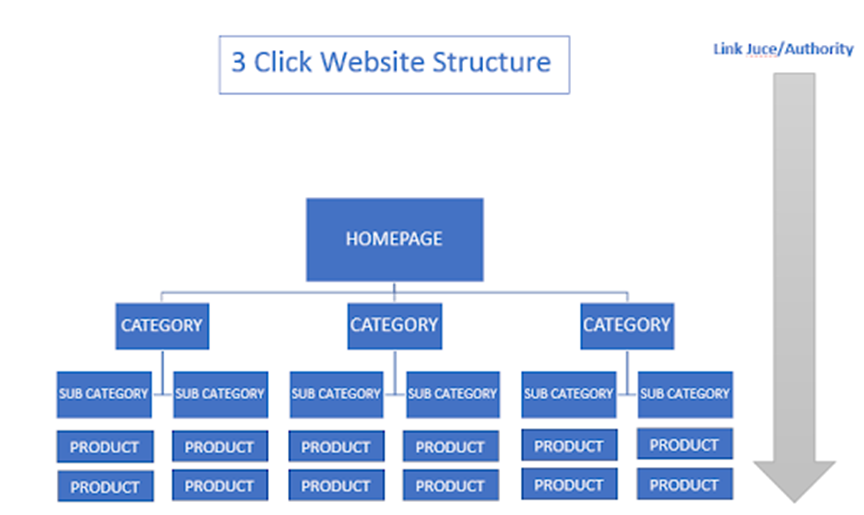
This method is also beneficial for SEO, as it helps Google index your web pages more effectively and further assists website visitors in finding the products they are looking for. It should be noted that the better the product pages are designed and optimized, the more likely they are to appear in the Search Engine Results Pages (SERPs), thereby attracting more organic traffic from search results.
Here is a simple example: The homepage sets four core categories: Men’s Clothing, Women’s Clothing, Footwear, and Accessories; the Women’s Clothing category is subdivided into subcategories such as Dresses, Tops, and Pants; each subcategory is directly linked to specific product pages.
(II) Make the URL Reflect the Hierarchical Relationship
The URL is the “intuitive business card” of the website structure. It must strictly correspond to the hierarchical structure and be concise and easy to understand. The correct URL format should include category and subcategory information. For example:
Category page: www.brandname.com/collections/women (where “collections” is a fixed category identifier and “women” represents the women’s clothing category)
Subcategory page: www.brandname.com/collections/women/dresses (where “dresses” clearly indicates the dress subcategory under women’s clothing)
Let’s take the example of the well-known fashion brand KiKi Love:
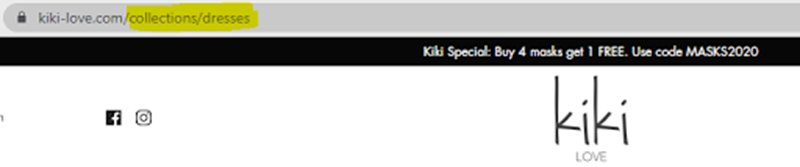
They use “Collections” as the category and “dresses” as the subcategory to facilitate navigation.
(III) Strengthen Page Linkage with Internal Links
Internal links are the “invisible bridges” of the fashion e-commerce URL structure. They can not only improve the smoothness of user navigation but also help search engines crawl more pages. Specifically, it can be done from two aspects: On one hand, link category and subcategory pages to each other. For example, add subcategory entrances such as “Dresses” and “Tops” on the “Women’s Clothing” page, and set links back to the category page on the subcategory pages. On the other hand, avoid “broken links” – regularly check the validity of links to ensure that users can jump to the target page accurately after clicking, and avoid user loss caused by invalid links.
(IV) Create a “Navigation-Friendly” Homepage
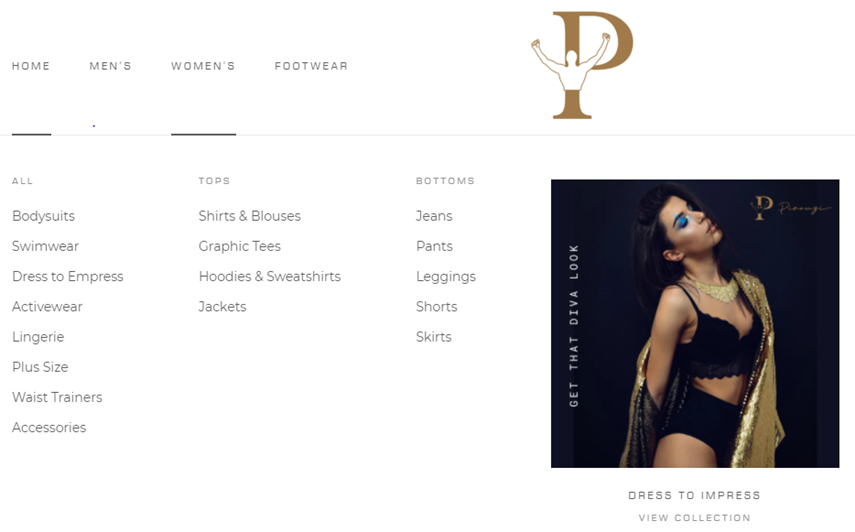
The homepage is the “front door” of a fashion e-commerce website and also the starting point of the URL structure. It needs to guide users through a clear menu design. It is recommended to set up a core category menu at the top of the homepage, such as “Men’s Clothing”, “Women’s Clothing”, “Footwear”, and “Accessories”, and adopt an interactive method of “displaying subcategories on hover” – when users hover the mouse over “Women’s Clothing”, subcategories such as “Dresses”, “Tops”, and “Pants” are automatically displayed, reducing the number of user clicks.
The homepage design of the fashion brand Pirouzi Official is worth referencing: The menu lists categories such as “Men’s”, “Women’s”, and “Footwear”. When you hover the mouse over each category, you can see the subcategories as shown in the picture below, allowing users to switch pages freely without relying on the “Back” button, which greatly improves navigation efficiency.
(V) Add Breadcrumb Navigation
Breadcrumb navigation is very useful because website developers can easily track the steps visitors take from the homepage to a specific page or website location. For example, this is how the well-known e-commerce platform Myntra does it:
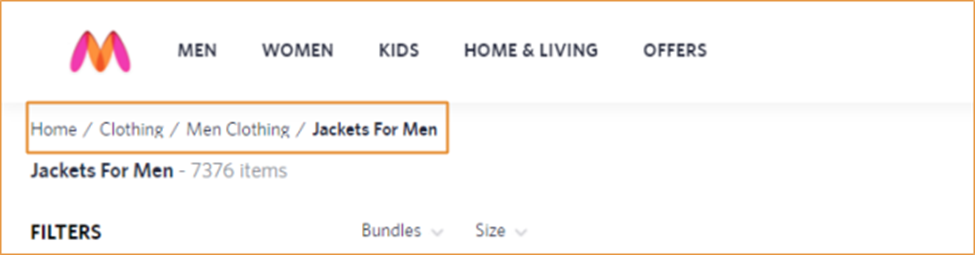
Breadcrumb navigation plays an important role in reflecting the e-commerce website structure and monitoring search engine robots when indexing website content. Therefore, it helps to shape the website’s SEO activities to achieve better online visibility and search engine rankings. In addition, it also helps to strengthen the internal link structure and enable visitors to navigate more reliably within the e-commerce website.
III. Three Core Values of a High-Quality URL Structure
(I) Bringing in More Organic Traffic
A high-quality URL structure is highly compatible with SEO – clear hierarchy, concise URLs, and effective internal links can help search engines index pages more comprehensively and improve the ranking of pages in search results. At the same time, optimized title tags and descriptions (matched with URL structure design) can also increase the user click-through rate, bringing more accurate organic traffic to the website.
(II) Driving Sales Growth
For fashion e-commerce, the core goal of the URL structure is to “reduce conversion resistance”. When users can quickly find target products and the navigation process is smooth, the probability of making a purchase decision will be significantly increased. For example, if a user searches for “women’s dresses” and can directly reach the product page through the flat architecture instead of going through multiple jumps, their willingness to convert will be significantly enhanced, which will drive continuous sales growth in the long run.
(III) Enhancing User Satisfaction and Website Usability
One of the core needs of fashion consumption is “pleasure”, and a chaotic URL structure will undermine this experience. A high-quality URL structure simplifies navigation steps and clarifies page connections, making it easier for users to shop – no need to search repeatedly for entrances or worry about getting lost. This “stress-free” experience can enhance users’ favorability towards the brand and even cultivate user loyalty.

Conclusion
Building the URL structure of a fashion e-commerce website is essentially about finding a balance between “user experience” and “search engine rules”. It does not require a complex design; it just needs to focus on the three core principles of “simplicity, clarity, and efficiency” to allow users to find products quickly and search engines to identify pages easily. When the URL structure truly serves the needs of “people”, increased traffic, improved conversions, and user satisfaction will naturally follow – this is exactly the key step for fashion e-commerce platforms to stand out in the fierce competition.